Occasionally, site specific architecture—designed purely for public enjoyment and recreation—crops up online and makes me want to pack my bags immediately and go and experience them for myself. Recent examples include Why Not Associates and Gorden Young's typographic Comedy Carpet in Blackpool, and further afield, New York's The High Line. One that grabbed my attention today is this vertiginous forest walkway in Estonia.
Other than imagining the wonder of the spectacle in the flesh, what I love about such installations is the fact that they are there to be experienced with no entrance fee, no intellectual symbolism and no spiritual veneer. They exist just for the enjoyment of being in the here and now, and engaging with good design that heightens a sense of a specific environment.
Thanks to City Of Sound for bringing this example to my attention.

Showing posts with label architecture. Show all posts
Showing posts with label architecture. Show all posts
Sunday, 8 January 2012


Sunday, 4 September 2011
Plantation Garden, shhh!
Yesterday, Claire and I took my Mum to a 'secret garden' in Norwich that some friends introduced us to last year. Started in 1856, the garden was abandoned after the Second World War, but has been slowly restored since the 1980s. It is one of those special places that demands you sit back and relax in wonder.

However, the reason for me posting about it here is to showcase these wonderful 'medieval' walls that run around certain sections of the garden, lining the banks of what was once a chalk pit.

I love the fact that found remnants of different buildings appear to have just been shoved into the wall as seemed appropriate at the time, creating a bespoke folk art memorial of different dwellings from the local area. A complete hodgepodge, it juxtaposes amusingly against the more formal aspects of the garden.


Alongside this, there are church window arches and gargoyles placed in flower boarders, seemingly at random, that give the place a strange quirkiness not dissimilar in feel to Clough Williams-Ellis' Portmeirion.

If you are in Norwich and want to get out of the hustle and bustle, then it's well worth finding the time to pay the gardens a visit. Check The Plantation Garden website for more details of its history, restoration, and more importantly, how to get there. Just don't tell too many people.

However, the reason for me posting about it here is to showcase these wonderful 'medieval' walls that run around certain sections of the garden, lining the banks of what was once a chalk pit.

I love the fact that found remnants of different buildings appear to have just been shoved into the wall as seemed appropriate at the time, creating a bespoke folk art memorial of different dwellings from the local area. A complete hodgepodge, it juxtaposes amusingly against the more formal aspects of the garden.


Alongside this, there are church window arches and gargoyles placed in flower boarders, seemingly at random, that give the place a strange quirkiness not dissimilar in feel to Clough Williams-Ellis' Portmeirion.

If you are in Norwich and want to get out of the hustle and bustle, then it's well worth finding the time to pay the gardens a visit. Check The Plantation Garden website for more details of its history, restoration, and more importantly, how to get there. Just don't tell too many people.
Mirror image

For some reason someone decided it would be a good idea to mirror the windows in the building behind the one I work in. This leads to a disconcerting sight every time I look out of the window; I see the roof of the building I'm in reflected back at me, below the roof of the building I am looking at! If I glance down, I see the windows of the floor below me. Windows within windows!

It has been like this all week, and it catches me out every time I turn around from my desk. Thankfully the floor height of where I am based and of those adjacent are different. I will therefore never catch a reflection of myself staring back at me as if standing in a different building. That really would be freaky.
Sunday, 7 August 2011
Above us only sky
Claire and I have just got back from a week in Lincolnshire. It's not a county that either of us knew, which is exactly why we chose it for a holiday destination. Apart from two seaside resorts of static caravans and amusement arcades, it was virtually devoid of tourists, which was to our liking and meant clear roads and empty sandy beaches. Lincolnshire hosts some striking scenery once you get out of the fens and into the Wolds, as well as some honest and welcoming market towns unspoilt by McDonald's and endless coffee chains. In fact, the most disappointing aspect was visiting the county city. Lincoln, despite the historic Cathedral area at the top of the appropriately named 'Steep Hill', which had our calves aching just looking at the cobbled road we had to climb, appeared to be one big shopping complex full of coffee chains and generic fashion and sports shops. We could have been in Chelmsford!
One of our great finds on the holiday, about 5 miles from where we were staying, was this Cloud Bar at Anderby Creek.

Thankfully it wasn't a beach bar serving cocktails and lager, but somewhere to go and watch clouds from. The Cloud Bar, endorsed by the Cloud Appreciation Society, is part of a project by Bathing Beauties: Structures On The Edge. According to their website, this is… "a new concept to integrate permanent small structures designed by artists and architects for the enjoyment and understanding of the coastal environment, on the extreme edges of the Lincolnshire coast."
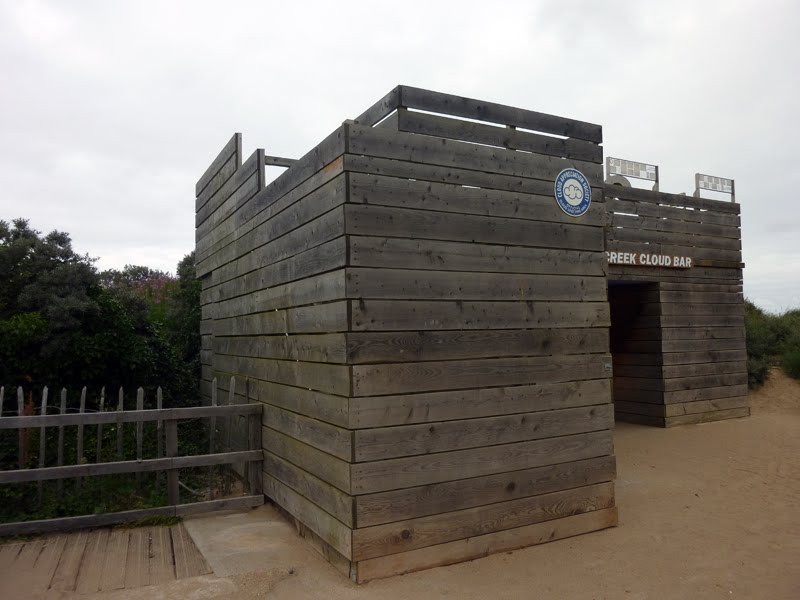
Set in sand dunes on the edge of a massive underpopulated beach, the bar is well worth a visit if you are in the area. Don't worry if you know nothing about clouds other than the fact they float above you in the sky, as there are loads of information panels on top of the single story hut.

I was particularly taken with these concrete seats designed for you to lay on and stare up at the sky. I like the fact they look as if they are brutalist clouds that have just fallen out of the sky, too heavy to float.

These sky mirrors are also a neat idea. You can rotate them to pick out and follow your favourite cloud and bring it down to Earth. Unfortunately it was a little too cloudy when we were there for these to work properly—you need it to be a brighter with breaks of blue sky to offset the edges of clouds to create distinction.

I also loved the fact that some of the information panels were printed on perspex panels which visually connected the physical phenonemon of clouds with the scientific explanation.

One panel dubbed cloud watching as a 'theatre of the skies', which is a rather nice phrase that will stay with me. As Lennon said, "above us only sky".
Links:
Wednesday, 23 March 2011
Sunday, 6 March 2011
The smell of linseed oil

Yesterday I spent some time trawling through old family photographs trying to find a decent portrait of Terry, my Uncle, for his obituary. My brother is currently writing this with someone Terry used to work with at English Heritage, in the hope we will get it published in The Guardian this/next week. While I found some great photos, unfortunately, none really seem suitable for an obituary.
However, during this search, I came across these photos of Terry's studio I took on one of my last visits to the home he and Christine had made in Walberswick. They took me back, and reminded me how privileged I felt being allowed into his creative space and him asking my opinion about the latest sketches he was working from. I had always loved spending time in his studio, even when, for the majority of his life, it consisted of a bedroom in a cramped council house in Rose Hill, Carshalton, Surrey. The smell of linseed oil, the stacks of canvasses leant up against walls, the scraps of newspaper clippings and open books that Terry would be using to fuel his visions. They all helped shaped my view of art over the years.


Then I came across a photo of a model I had forgotten about. Terry and Christine had recently had this studio built—previously he had been working in a small back room that was cold and damp. Terry being Terry had made a model to get a sense of what the extention would be like on completion. This was something he would often do when working on his reconstruction artworks for English Heritage and Cadw, architectural research that gave him a sense of scale and perspective for his paintings. I would gaze in wonder at them as a small boy and I did so again when I saw this on this visit—I've never been particularly good with 3D myself. But what I really like about this crude model is that he has carved a figurine of himself—here he is coming down the stairs.

This personalisation of his work is something that I would also see in his reconstruction artwork. Occasionally I would see some of these staring out at me in an English Heritage guide book and think, "is that monk there my Dad?" Or, "that servant looks a lot like photographs I have seen of my grandmother as a small girl". And of course, like many artists, he would draw himself in, the bald head and thick set mustache being a dead give away.
I also came across a photo of a catalogue of his reconstruction artwork I put together for him about 10 years ago. I think he was hoping to get it published, but unfortunately that never happened.

A slight irony that strikes me as I look at these photographs is that on the night he died, the week before last, I was actually putting together a lecture for students at UCS about workspaces, albeit from a graphic designer's perspective. I haven't yet given that lecture and maybe when I do get around to it I'll include some of these shots. Until then, they can be seen on my Flickr account in their own set.

Dubdog@Flickr
Sunday, 13 February 2011
Weekend roundup

A quick round up of things seen on my weekend in Brighton last week. Briefer than I would wish, but time's pretty restricted at the moment.
First up is a statue of Max Miller just outside the Brighton Dome. I didn't really register the statue until Claire pointed out that it had a piece of knitted graffiti attached to it. Apparently this is quite trendy.

We saw the statue on leaving the ever excellent Brighton Museum and Art Gallery. I posted from our B and B last week about how much I enjoyed the Capturing Colour exhibition at the Museum, but haven't really had a chance to talk about the rest of the venue. There are some great exhibits of modernist furniture and paintings, as well as really well put together displays about Brighton's social history, of which it has plenty. There's too much to go into here, and needless to say photos will be up on Flickr over the coming week, but this quote on the wall near a section about cycling has to be posted, (excuse the poor image quality).

The other aspect of the museum I want to mention is the fashion section. What I like about this is the fact that much of it is about street fashion, and lots of the clothes are donated by locals, with back story.


On some items they even has responses from local school children. I wonder whether Tony Lord ever did use his belt to repel vampires?


On the return journey, we decided to take in the De La Warr Pavilion in Bexhill-on-Sea, another modernist masterpiece.

Apart from the fact that it's always good to pop into this magnificent building, one of the things that drew us on this occasion was the Moving Portraits exhibition.

While I'd seen several of the pieces on display before, particularly Sam Taylor-Wood's David and the Gilbert and George Living Sculptures, what I wasn't expecting was to be bowled over by anything by Andy Warhol. His Screen Tests 64-66 gave an eerie sense of voyeurism as I looked at famous icons from the 60s who were all staring back at me, in complete silence. Wondering what was going through their minds is a natural reaction, steeped as many of them are with cultural significance, but I found them strangely powerful as well—the addition of motion seems to have given the traditional portrait not only life (obviously), but somehow made the subjects more tangible and ordinary, given that our relationship with these people is usually through the eyes of the media. I got the feeling I was being given a very personal and intimate audience with them. Particularly when, (spoiler alert) unexpectedly one of them, Susan Sontag I think, starts to cry. Very powerful stuff.
Other highlights included Margaret Tait's Portrait of Ga in which the unwrapping of a sticky sweet seems to suggest more about the personality conducting the action than seeing her going about her daily routines in the rest of the film. She wants the sweet, the simple pleasure, but is so very careful not to get her fingers sticky. I also enjoyed Candice Breitz' Factum Misericordia, where two identical twins are interviewed on camera, asked exactly the same questions and sat in exactly the same chair so that the only difference you could tell was in their narration, their individual take on their experiences as one of a twin, and how they felt they related to each other. The editing of the interviews, shown side by side, and the sound track running out of sync and switching screens added to the draw of trying to relate to these two people as individuals talking about their collective experience.
Highly recommended, and free.
Links:
Knitted graffiti
Saturday, 10 July 2010
Stasis symbol
In 2003 I took a series of photographs of buildings on Ipswich quay. These concrete beasts were a local landmark and due to be demolished to make way for a redevelopment of the area.

Good news though, I heard a couple of weeks ago that work is to start on this building again, once new student accommodation being built on the waterfront has been finished in August. All we need now is a little joined up thinking to create a joined up town because unless you are a student, tourist, yacht owner, work on the waterfront, use the quay as a cut through to the station or have the luxury of extended lunch hours and expense accounts, you're unlikely to go there often, if at all.


One of the malt stores in 2003
This is what I wrote about these photographs in 2008…
"I had always been attracted to these buildings situated on Ipswich Quay. Sheer monuments to function, they lacked any flourish of decoration; their only purpose was purpose. I saw a beauty in these audacious concrete monoliths that, once I learned they were to be demolished, I had to capture. They have since been razed to the ground and replaced with flats for people who own yachts."
In their place we now have:
A second Pizza Express
The Jerwood DanceHouse
Several Bistros and Cafes
The Mill, a 23 story apartment block
An extension to a hotel
More flats
Unfortunately, the town planners have so far failed to address the two busy roads that separate the town centre from the quay. This forms a physical and psychological barrier and unless you have a specific reason to be there, you literally have to go out of your way to enjoy this part of town. Therefore, the artistic impressions drawn up for the planning stages of this regeneration are more populated than the reality. To be fair, it is much more populated than previously, when people had to dodge large grain lorries. And now the waterfront university is establishing itself, you can see the potential.
Unfortunately, there is still an element of stasis, as work stopped on another apartment block a year ago and it has stood skeletally dominating the skyline ever since. An enormous metaphor for the recession.

This is what I wrote about these photographs in 2008…
"I had always been attracted to these buildings situated on Ipswich Quay. Sheer monuments to function, they lacked any flourish of decoration; their only purpose was purpose. I saw a beauty in these audacious concrete monoliths that, once I learned they were to be demolished, I had to capture. They have since been razed to the ground and replaced with flats for people who own yachts."
In their place we now have:
A second Pizza Express
The Jerwood DanceHouse
Several Bistros and Cafes
The Mill, a 23 story apartment block
An extension to a hotel
More flats
Unfortunately, the town planners have so far failed to address the two busy roads that separate the town centre from the quay. This forms a physical and psychological barrier and unless you have a specific reason to be there, you literally have to go out of your way to enjoy this part of town. Therefore, the artistic impressions drawn up for the planning stages of this regeneration are more populated than the reality. To be fair, it is much more populated than previously, when people had to dodge large grain lorries. And now the waterfront university is establishing itself, you can see the potential.
Unfortunately, there is still an element of stasis, as work stopped on another apartment block a year ago and it has stood skeletally dominating the skyline ever since. An enormous metaphor for the recession.

This town is coming like a ghost town
In some ways this is a fitting tribute to the old concrete malt stores that stood on this site for many a year. It's a shame that it is all boarded off though, and you can't freely walk around this ghostly structure.

In some ways this is a fitting tribute to the old concrete malt stores that stood on this site for many a year. It's a shame that it is all boarded off though, and you can't freely walk around this ghostly structure.

Good news though, I heard a couple of weeks ago that work is to start on this building again, once new student accommodation being built on the waterfront has been finished in August. All we need now is a little joined up thinking to create a joined up town because unless you are a student, tourist, yacht owner, work on the waterfront, use the quay as a cut through to the station or have the luxury of extended lunch hours and expense accounts, you're unlikely to go there often, if at all.

Subscribe to:
Posts (Atom)